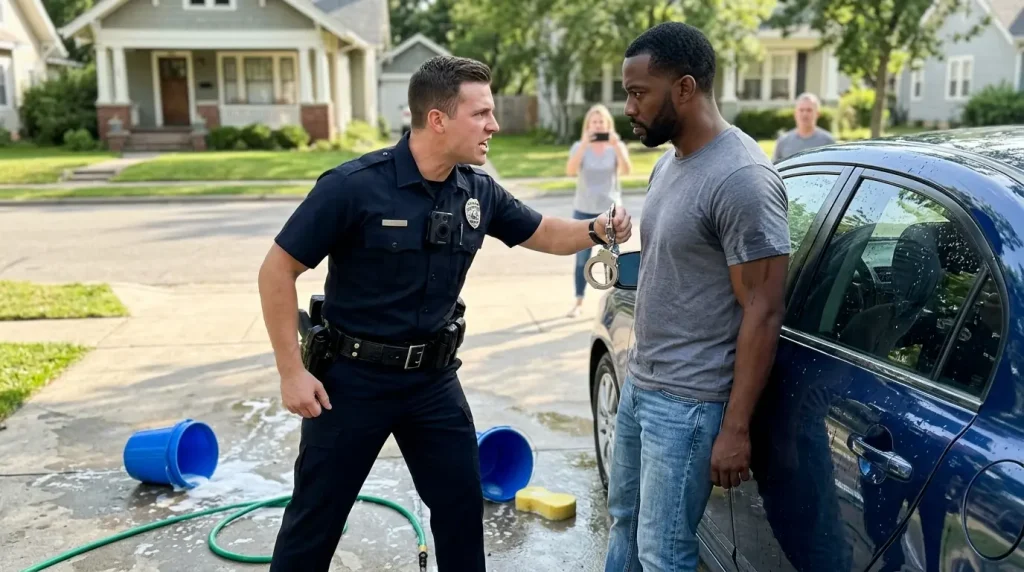
The Officer Harassed a Black Man for Washing His Car, Unaware the Man Was His Police Sergeant and His Career Was About to End
“We got a call about someone who didn’t look like they belonged here. I need to see some ID.” “I live here. I’m literally washing my car in my own driveway.” “Just cooperate and we’ll be done here.” “You really going to do this?” “Sir, don’t make this harder than it needs to be.” “I’m […]
▶ Start ReadingAll parts
Press Start above to readPart 1 / 12
“We got a call about someone who didn’t look like they belonged here. I need to see some ID.” “I live here. I’m literally washing my car in my own driveway.” “Just cooperate and we’ll be done here.”
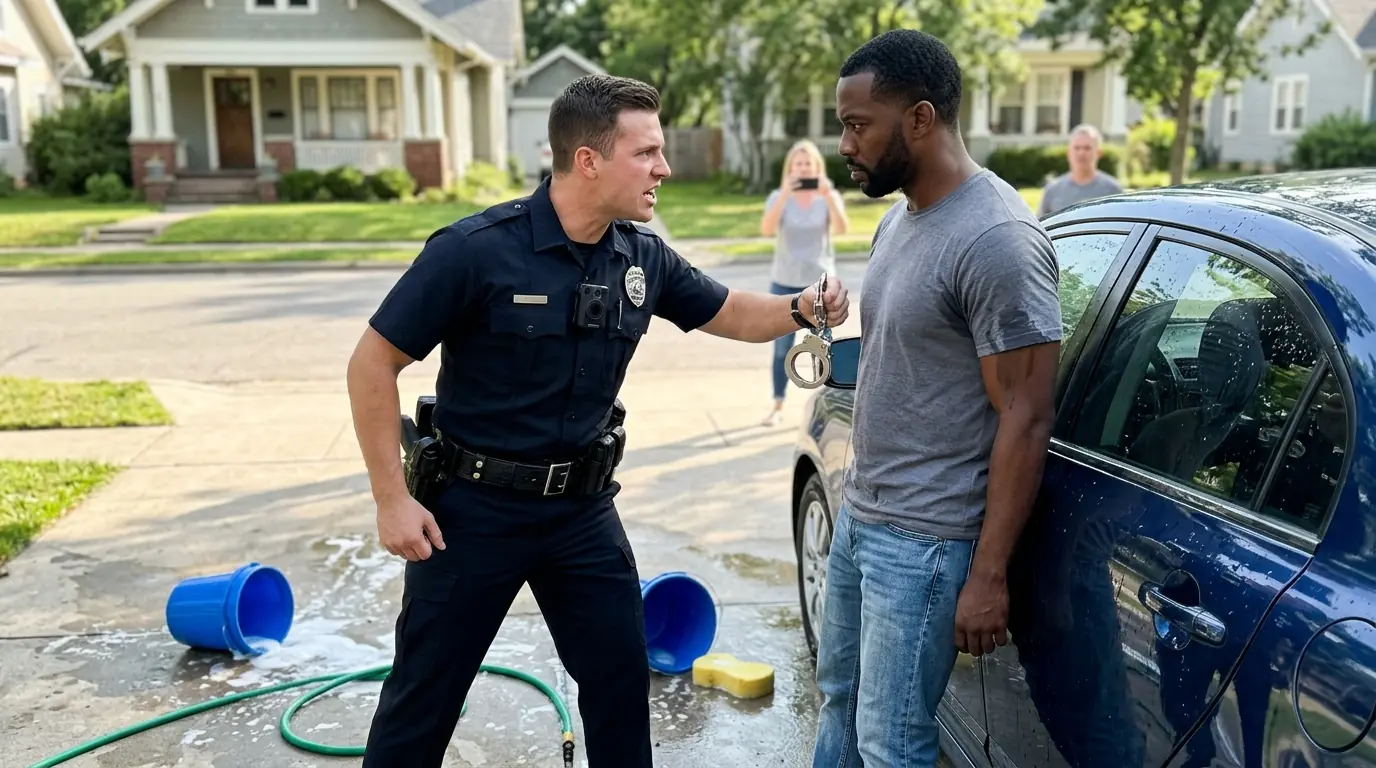
“You really going to do this?” “Sir, don’t make this harder than it needs to be.” “I’m Sergeant Darnell Whitmore. I’m sure you recognize my name. Now, I need your badge number because you’re in big trouble.”
The silence that followed lasted exactly 4 seconds. But in those 4 seconds, Officer Trevor Castellano’s entire world collapsed. The man he had just told to cooperate, the person he had profiled as someone who didn’t look like they belonged, was not just a citizen. He was a 15-year veteran of the police department. He was a decorated sergeant, and as of 3 weeks ago, he was Castellano’s direct supervisor in the East Division Patrol Unit.
This wasn’t going to be a routine call that Castellano could write up and forget about. This was going to be a career-ending encounter that would be studied in police academies for years to come. And Castellano’s own body camera was recording every single word. Trevor Castellano had been with the police department for 4 years. He was 28 years old, married, and considered himself a good cop.
He had grown up in a mostly white suburban area about 30 miles from the city where he now worked. His father had been a police officer, and Castellano had always wanted to follow in his footsteps. He had gone through the police academy, graduated in the middle of his class, and been assigned to the East Division. His record showed 14 commendations for good police work. He had made several solid arrests, helped with community events, and his supervisors had always rated him as competent.
But there was something else in Castellano’s file that hadn’t been addressed. Over his 4 years, he had received nine complaints from citizens alleging racial profiling or inappropriate conduct. All nine complaints had come from black or Latino residents. All nine had been investigated and marked as unfounded or unsubstantiated. The complaints had been investigated by his previous supervisor, Lieutenant Vernon Kowalski, who was known for protecting his officers and dismissing most civilian complaints as people trying to get out of legitimate police work.
More Stories
 NEW The Bullies Refused to Listen as He Begged Them to Stop at the Picnic, But What They Did Next Left the Whole School Furious
The Bullies Refused to Listen as He Begged Them to Stop at the Picnic, But What They Did Next Left the Whole School Furious
 NEW A Cocky Champion Mocked a Quiet Woman in Front of 800 Fans, Never Expecting One Move to Change Everything
A Cocky Champion Mocked a Quiet Woman in Front of 800 Fans, Never Expecting One Move to Change Everything
 NEW In Front of 600 Fans, an Arrogant Black Belt Underestimated a Quiet Black Woman, Never Expecting His Confidence to Crumble
In Front of 600 Fans, an Arrogant Black Belt Underestimated a Quiet Black Woman, Never Expecting His Confidence to Crumble
 NEW A Confident Fighter Challenged a Farmer to Last Three Minutes for $500, But He Was Stunned When the Farmer Accepted
A Confident Fighter Challenged a Farmer to Last Three Minutes for $500, But He Was Stunned When the Farmer Accepted
 NEW An Arrogant Fighter Offered a Farmer $500 to Last Three Minutes, Never Expecting Him to Accept the Challenge
An Arrogant Fighter Offered a Farmer $500 to Last Three Minutes, Never Expecting Him to Accept the Challenge
 NEW He Thought No Farmer Would Dare Accept His $500 Challenge, Until the Man Agreed to Last Three Minutes
He Thought No Farmer Would Dare Accept His $500 Challenge, Until the Man Agreed to Last Three Minutes
NEW The Quiet Black Woman Was Underestimated by a Cocky Black Belt, But His Smug Grin Disappeared in Front of 600 Fans
The Quiet Black Woman Was Underestimated by a Cocky Black Belt, But His Smug Grin Disappeared in Front of 600 Fans
 NEW He Thought Humiliating a Quiet Black Woman Would Be Easy, Until the Arrogant Black Belt Lost His Smile Before 600 Fans
He Thought Humiliating a Quiet Black Woman Would Be Easy, Until the Arrogant Black Belt Lost His Smile Before 600 Fans